
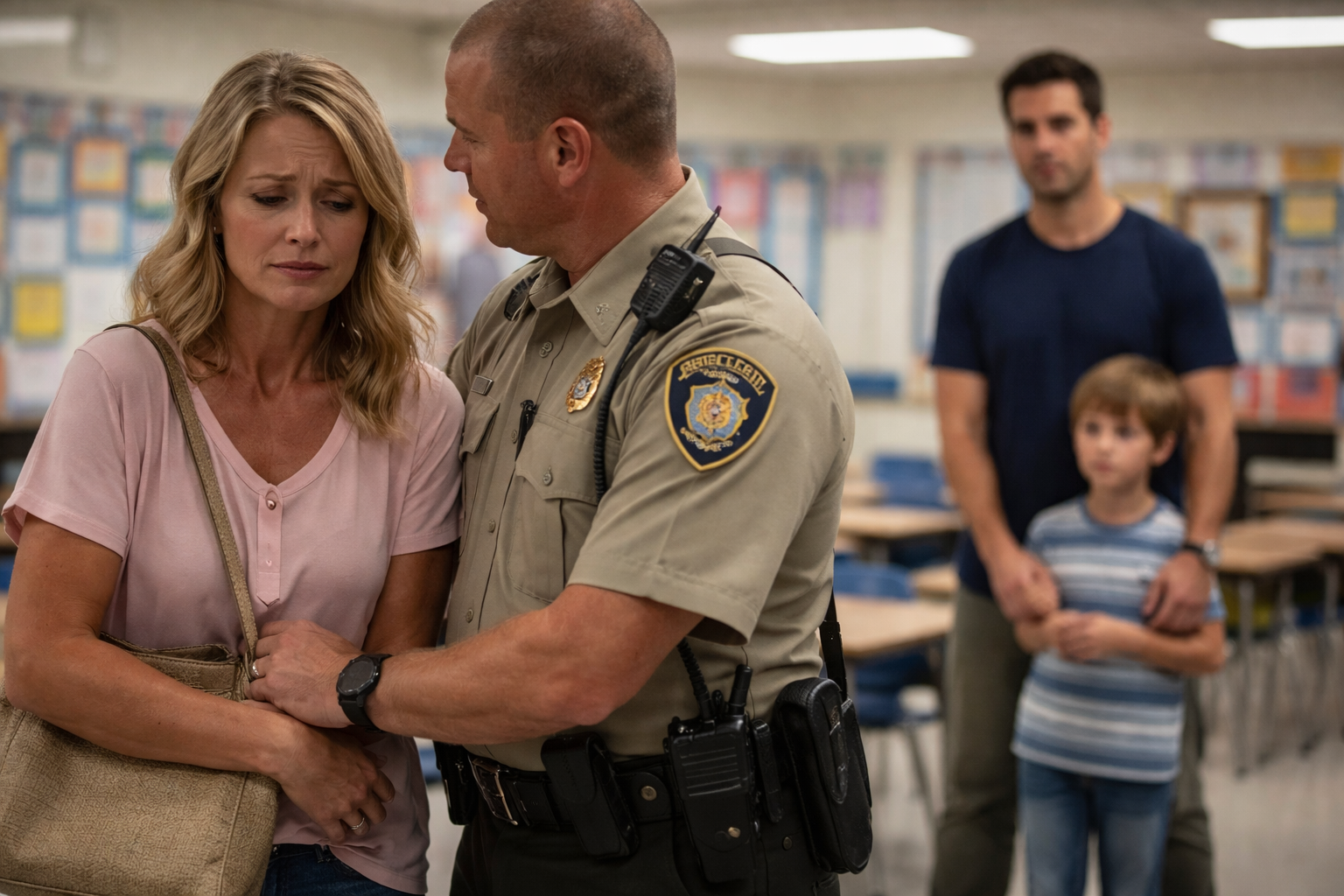
The night I learned just how far Mitchell was willing to go.
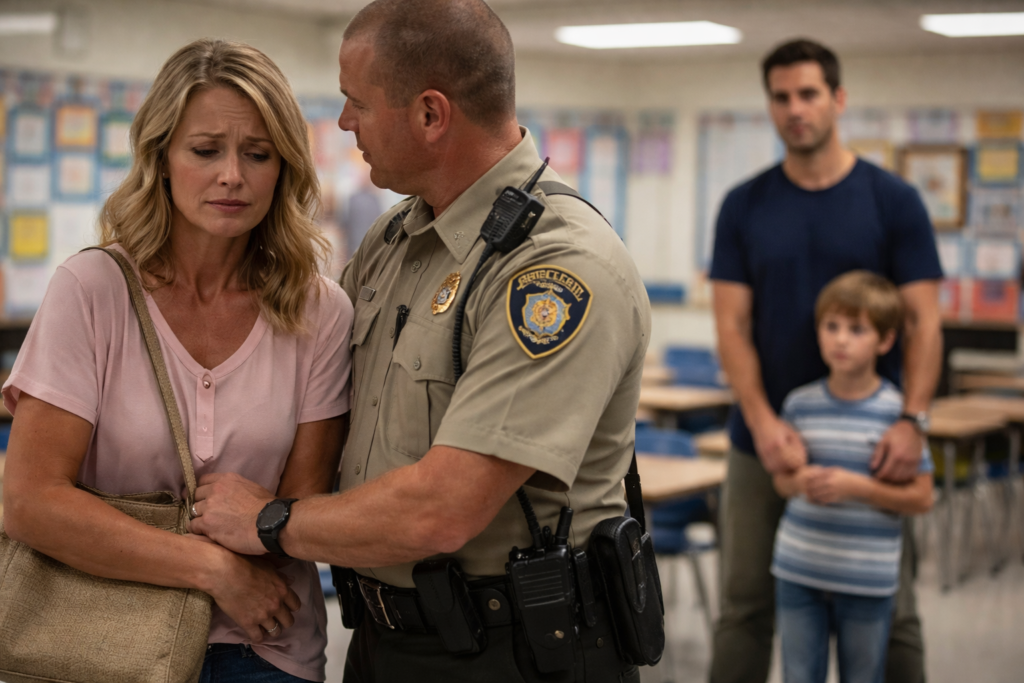
Four months since he filed for divorce, and I was still learning how to breathe again without choking on shame. Still learning how to smile in public when my insides were splintered. Still pretending I wasn’t unraveling—thread by thread—while trying to keep our son, Samuel, untouched by the wreckage.
It was his school open house.
One of those nights that’s supposed to be light and hopeful. New beginnings. Fresh notebooks. Excited chatter echoing through hallways that smell like disinfectant and crayons. I told myself this night wasn’t about me. It was about Samuel. So I swallowed hard, stitched a smile onto my face, and took his hand.
We walked the halls together—hand in hand, like almost every other parent and child there. I kept my grip steady, my voice cheerful. I pointed out bulletin boards. We laughed when we ran into familiar faces. Inside, I was fighting the quiet humiliation that had followed me everywhere since the divorce filing. Outside, I was just another mom doing her best.
Mitchell had never cared much about open houses before.
But now—now—with a divorce case unfolding, suddenly he wanted to be seen. Suddenly he wanted to look like the involved father.
While Samuel and I were sitting in his new classroom, filling out paperwork and locating his desk, Mitchell walked in.
No greeting. No acknowledgment of me.
He went straight to the teacher and pulled her into a private conversation.
My heart started pounding so hard I could hear it in my ears. I knew that charm. I had lived with it for years. I watched him lean in, smile easily, control the space—as he always did. I felt small. Invisible. Replaceable.
Then he started calling Samuel.
Once.
Twice.
Again.
Samuel didn’t want to leave yet. He wanted to stay with me, to finish looking around, to enjoy his night.
Mitchell kept calling him.
Finally, I spoke up. My voice shook, but I didn’t back down.
“Leave him alone. We’re not finished here yet.”
Mitchell walked out.
Or so I thought.
A few minutes later, the teacher came over and quietly told me that Mitchell had already filled out Samuel’s paperwork for the new school year. He had never filled out any school papers before.
As she reached across the desk and took the forms that were sitting directly in front of me.
My stomach dropped.
I had always handled the school paperwork—addresses, emergency contacts, authorized pickups. I asked her if I could please have copies of whatever Mitchell had filled out. She nodded and headed toward the copier.
Trying to keep the night normal, I asked Samuel where he wanted to go next.
“The lunchroom,” he said excitedly. “And the music room!”
We made a plan. I tucked the copies into my purse without looking. I couldn’t bear to see what he’d written. Not yet. That pain was for later. For privacy.
Hand in hand, we left the classroom.
As we headed down the hallway toward the music room, my phone buzzed.
It was another mom—someone I’d been a room mom with the year before.
Her message stopped me cold.
Mitchell is following you.
He’s taking pictures.
I felt the air leave my lungs.
I forced myself not to react, slowly turning my head just enough to confirm what my body already knew.
There he was.
Six-foot-two.
About ten feet behind us.
Camera raised.
Filming.
I refused to let him ruin Samuel’s night.
I kept walking. I kept talking. I asked Samuel which friends he hoped to see. I kept my voice calm while my hands trembled. When we entered the music room, Samuel lit up. He ran to his friends, hugging them, laughing like nothing was wrong.
For five minutes, I let myself believe we’d made it through.
Then the school resource officer—Billy—approached me.
I knew him from Cub Scouts. His son attended the same den as Samuel. I expected small talk.
Instead, he asked me to walk with him to the principal’s office.
Alarmed, I asked why.
His answer knocked the ground out from under me.
“Mitchell made a report,” he said, “that you’re trying to leave the school and kidnap Samuel.”
I turned to look at my son just as Mitchell walked into the music room and went straight to him—while I was calmly escorted away.
I was shaking.
In the principal’s office, Billy told me to sit tight. When he stepped out, I reached into my purse and quietly pressed record on the slim audio recorder I’d been advised to carry everywhere. Record everything, they’d told me. For your safety.
Billy returned and told me that Samuel had arrived with Mitchell and would be leaving with him.
I reminded Billy—gently but firmly—that I didn’t even have a car at the school. That he personally saw me being dropped off by the Cub Scout den leader. He acknowledged it immediately.
“I can’t kidnap my own son,” I said. “And you know that.”
His face changed.
What followed was over an hour of conversation—raw, humiliating, devastating.
Billy admitted something I’ll never forget.
“I know you think Mitchell and I are close because of Cub Scouts,” he said, “but I’d be lying if I didn’t say I think he has serious issues and needs counseling.”
I cried openly.
This was my child’s open house. Not a crime scene. Not an interrogation. Not a custody battlefield.
Billy told me Mitchell had produced photos—photos of me holding Samuel’s hand—and claimed that was proof I was trying to talk him out of the building.
I reminded Billy again: I had no vehicle. When it was time to leave, I planned to call a friend.
What I didn’t say out loud—but knew in my bones—was that my car had been destroyed the week before. Sugar poured into the gas tank. An eight-year-old car with low mileage. A gift from my father. No locking gas cap.
Someone had done it.
Billy left to speak with Mitchell.
Another hour passed.
Samuel was kept in another room with administrators. Safe—but separated from me.
When Billy returned, it was dark outside. The clock read 8:00 p.m. The open house had ended an hour earlier.
Samuel would be leaving with Mitchell.
I didn’t argue. By then, Mitchell had already taken control of everything—my home, my access, my life.
Billy told me Mitchell was pressuring him to write an incident report accusing me of attempted kidnapping. Billy refused.
“No crime occurred,” he said. “And Samuel himself said you weren’t trying to leave with him.”
I begged to see my son.
Billy arranged for it.
I wiped my tears. I hugged Samuel tightly. I told him how proud I was. How excited I was for his school year. How much I loved him.
My son knew something was wrong.
He left without me.
I watched him walk away with Mitchell from the principal’s office, my heart shattering with every step.
Thirty minutes later, an officer drove me home.
I sat in the back of a patrol car, staring out the window, numb.
I didn’t know then that it wouldn’t be the last time.
But I knew one thing for sure:
That night was not about an open house.
It was about power.
And Mitchell was just getting started.
After the Open House
When I finally got home, the house felt cavernous and cold, like it no longer belonged to me.
I sank onto the sofa and just sat there—still, hollow, humiliated. The silence was loud. No footsteps. No laughter. No Samuel. Just the weight of everything that had happened pressing down on my chest until it hurt to breathe.
My purse sat beside me.
I knew what was inside.
With shaking hands, I reached in and pulled out the copies of the school paperwork the teacher had made for me. The papers I couldn’t bring myself to look at earlier. The papers Mitchell had filled out while I sat ten feet away—unaware that he was erasing me in real time.
I unfolded the first page.
The address listed was the marital home.
His home now.
Under “Father,” he checked his name.
Under “Primary Parent,” he checked himself.
My stomach twisted.
Then I scanned the emergency contacts.
First: his father.
California.
Second: his mother.
Arizona.
I read it again.
And again.
Nowhere.
Not once.
Not in any box, margin, or afterthought—did he list me.
Samuel’s mother.
The woman who carried him.
The woman who stayed home with him for seven years.
The woman who packed every lunch, wiped every tear, attended every school function, doctor’s appointment, and Cub Scout meeting.
I wasn’t “forgotten.”
I was deliberately erased.
The realization hit me like a physical blow.
This wasn’t carelessness.
This wasn’t oversight.
This was strategy.
Mitchell didn’t just want control—he wanted absence. He wanted me gone, not only from the marriage, but from Samuel’s life altogether. Replaced by people who lived thousands of miles away. People who couldn’t get to the school in an emergency. People who weren’t there for bedtime stories or scraped knees or nightmares in the dark.
He chose anyone but me.
I felt rage ignite beneath the grief—hot, sharp, consuming.
How could someone be so calculated? So cruel? So willing to weaponize a child just to win?
I told myself this would matter.
This is evidence, I thought.
No judge will ignore this.
This was proof of intent. Proof of alienation. Proof that he was already rewriting reality, already painting a world where Samuel had a father—and no mother.
I clung to that belief. I needed to.
But when the time came, it didn’t matter.
The judge barely reacted. No outrage. No acknowledgment of the implications. At one point, Mitchell was simply directed to “add the mother” to Samuel’s school records.
Add me.
As if I were an afterthought.
As if I were optional.
As if my presence in my child’s life required permission.
I sat there, holding those papers, realizing something far more terrifying than the open house itself.
This wasn’t going to be a fair fight.
Mitchell wasn’t playing by the rules of decency, truth, or love. He was playing a long game—one where humiliation, false narratives, and quiet erasures were weapons.
And that night, alone on my sofa, with my son gone and my name missing from his life on paper, I understood something with devastating clarity:
The open house was only the beginning.
And the system that was supposed to protect us…
was already looking the other way.
Leave a Reply